
Analysis and planning
Identify what matters. Choose your next step.
We help you understand the development needs of your current Oracle environment and assess your options for modernisation. We bring business goals, processes and the current technical environment together into a well-founded recommendation and a clear roadmap.
A well-founded view before your next decision
The need for change may show up as manual work, slow reporting, recurring incidents or difficulty responding to new business needs. A new system is not always the answer. The first step is to identify what genuinely needs to change and what can be retained from the current environment.
Analysis helps when there are several options, but their benefits, dependencies or implications are not yet clear enough. The scope may be a single process, application or integration — or a broader Oracle environment.
Four perspectives on your current environment
Business and processes
What goals should the environment support? We identify workflow bottlenecks, manual work and key user needs.
Applications, data and integrations
We examine the overall architecture, data flows and dependencies. We assess how current capabilities are used and how readily information is available.
Reliability and maintainability
Within the agreed scope, we review incidents, maintenance practices, documentation and change management.
Development opportunities and AI
We assess where automation, analytics, new capabilities or AI could add value — and what would be needed to use them.
From findings to options
We distinguish symptoms from their underlying causes. We compare appropriate ways forward: making better use of the current solution, targeted improvements, extensions or modernisation.
The recommendation considers the expected benefits, feasibility, cost drivers, risks and dependencies. Retaining the current way of working can also be a justified conclusion.
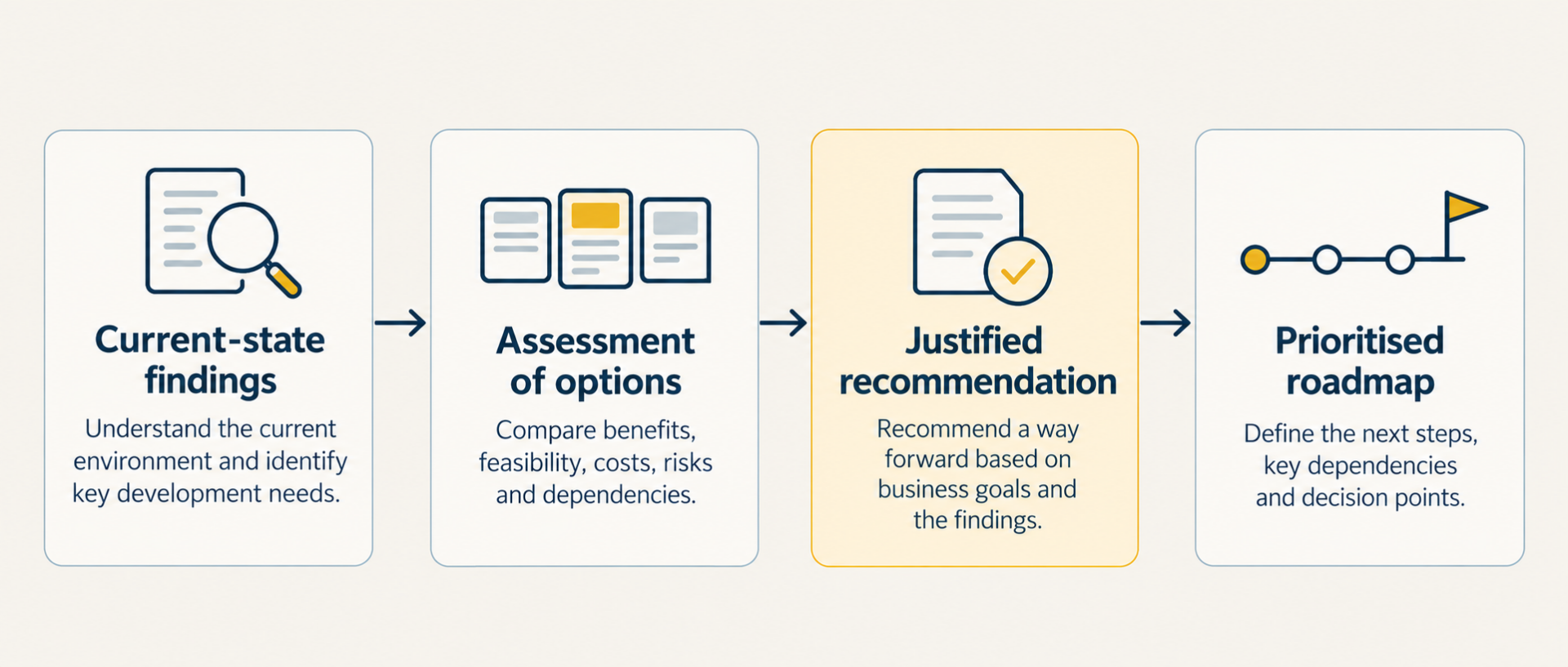
What does the analysis deliver?
- A shared view of the current situation and key findings.
- Prioritised development needs and their business rationale.
- A comparison of agreed options and a recommendation on how to proceed.
- A roadmap, key dependencies and decision points.
- Effort and cost estimates at an agreed level of detail, including their assumptions.
Deliverables and their level of detail are agreed at the start. The purpose is to support a decision, not to produce a stand-alone report.
How the work progresses
1. Define the question
We agree on the goals, scope, information needed and the decision the analysis should support.
2. Understand the current situation
We review the agreed materials and speak with those responsible for processes, systems and maintenance.
3. Assess the options
We bring the findings together and compare realistic ways forward. We also highlight uncertainties and any need for further investigation.
4. Agree on the next step
We review the recommendations together and identify what can be done immediately and what requires more preparation.
What is the next step?
Implementations and transformation projects →
For implementing a new solution or delivering a broader transformation.
For improving the value of your existing environment, step by step.
Maintenance and support services →
For clearly defined support and maintenance that keep everyday business running.