
Continuous improvement
More value from every improvement.
We develop your Oracle environment as business needs evolve. Together, we prioritise improvements, deliver them in manageable increments and monitor their impact.
Not everything needs to change at once
Business continues to evolve after a system is in use. User needs become clearer, new decisions require information, and manual work reveals opportunities for improvement. At the same time, some capabilities of the current solution may remain unused.
Continuous improvement turns these observations into prioritised work. Together, we select the most valuable development areas and deliver them in manageable increments. The starting point is the intended impact, not a disconnected list of technical changes.
Improvements where they add value
Making better use of existing capabilities
We improve ways of working, configuration and user experience within the agreed scope. Not every improvement requires a new application.
Processes and integrations
We reduce agreed manual steps and improve data flows between systems. Each change is designed as part of the complete workflow.
Data, reporting and analytics
We improve data quality, availability and use. The aim is shared, usable information for everyday decisions.
Extensions, automation and AI
We assess new opportunities based on the use case. Implementation also covers responsibilities, testing and the prerequisites for ongoing use.
A shared backlog makes priorities visible
We bring needs from the business, users and maintenance into a shared development backlog. For each selected item, we clarify the goal, owner and acceptance criteria.
Prioritisation balances benefits, feasibility, effort, risks and dependencies. Agreed capacity and cost monitoring help keep the work manageable. Not everything needs to be decided in advance, but the goal of the next increment must be clear.
Turning development steps into everyday improvements
1. Identify and clarify
Define the problem, intended benefit and current situation together with the owner of the change.
2. Prioritise and agree
Select the next increment and agree on scope, responsibilities and acceptance criteria.
3. Implement and test
Build the change and verify that it works, including its effects on related processes and systems.
4. Put into use and evaluate
Confirm user readiness and monitor the agreed effects. Use the findings to refine the next development steps.
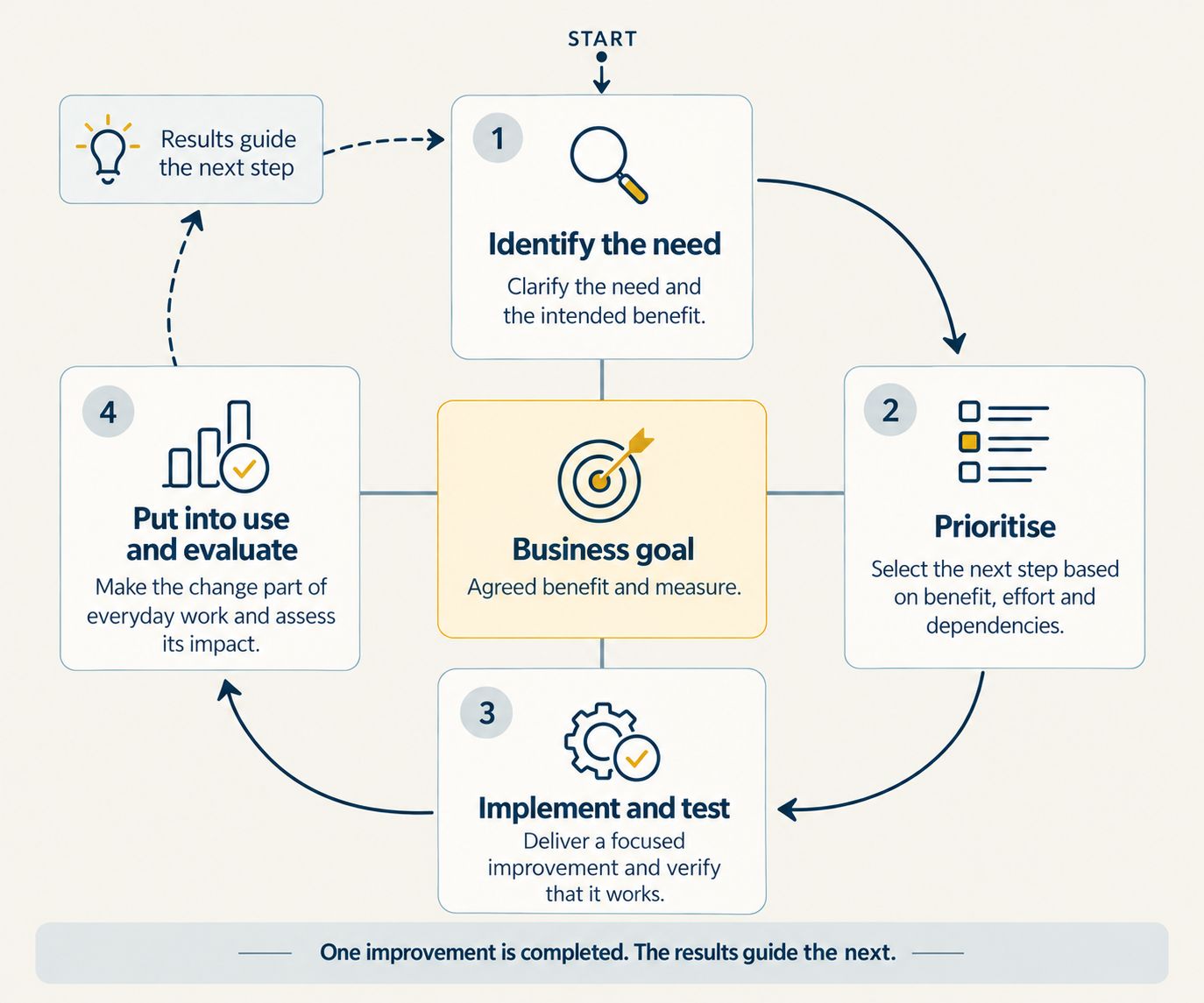
Example: Improving a recurring manual task starts with defining the current situation and the goal. A targeted improvement is implemented and tested, after which its effect on workload and errors is assessed.
Evaluate the impact using agreed measures
Success can be assessed through measures such as the amount of manual work, processing time, errors, adoption of a new capability or user feedback. The measure and baseline are selected for each improvement.
We do not promise the same benefit for every change. What matters is making assumptions visible and checking after implementation whether the original need has been addressed.
When is a separate project needed?
A broad change, significant system dependencies or a major go-live may require a separate project. Continuous improvement and transformation projects do not compete with each other: they are different ways to deliver changes of different sizes.
If the options or the scope of the change are not yet clear, analysis and planning help identify the right approach.
What is the next step?
For a well-founded view of your current environment and the options ahead.
Implementations and transformation projects →
For implementing a new solution or delivering a broader transformation.
Maintenance and support services →
For clearly defined support and maintenance that keep everyday business running.